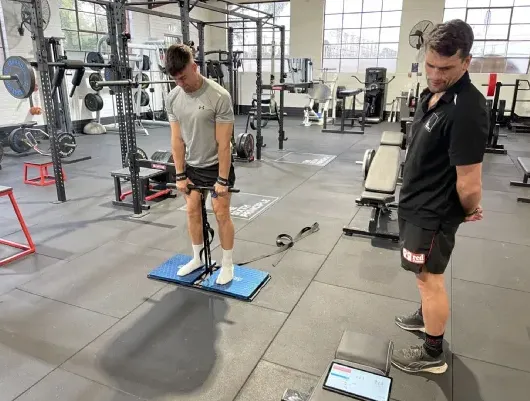
Strength assessment tools help turn movement and effort into clear, measurable data that supports better decision-making.
Since measuring strength is a key part of rehabilitation, sports performance, and clinical care, relying only on visual observation or manual testing can make it hard to track real progress over time.
Modern strength testing systems give clinicians objective numbers instead of estimates. These measurements help guide treatment plans, document progress, and support a safe return to activity.
Manual muscle testing has been used in therapy for many years, but it has limits. Results can change from one clinician to another, and small strength gains may be missed. This can make progress harder to measure.
Objective strength assessment tools help by:
Using numbers instead of ratings helps clinicians better see how strength changes during recovery.
Strength testing systems are used in a wide range of settings, including:
These tools are used to measure grip strength, push and pull force, and other movements needed for daily tasks and job duties. This helps connect strength gains to real-world function.
 | AxIT Strength Assessment System for Rehab, Sports, and Performance by Strength by Numbers View Product |
The AxIT Strength Assessment System is built to measure strength in a clear, accurate, and repeatable way. It uses digital technology to record exact force values during testing, which helps remove guesswork from strength assessments. This makes it useful in both clinical care and performance settings where reliable data matters.
Clinicians can use AxIT to evaluate baseline strength, track progress over time, and support clear documentation. The system captures consistent results across sessions, helping ensure that changes in strength are real and not based on estimation.
By turning strength testing into precise, easy-to-read data, the AxIT Strength Assessment System helps support better decisions, clearer communication, and higher-quality care.
A higher initial cost to start, but the instant, more accurate results lead to simplified documentation and higher patient and clinician satisfaction overall.
.jpg&newwidth=365&maxheight=200 "Baseline Pneumatic Squeeze Bulb Dynamometer") | Baseline Pneumatic Squeeze Bulb Dynamometer View Product |
This pneumatic squeeze dynamometer measures hand grip strength using air pressure instead of rigid parts, which helps make testing more comfortable and repeatable.
This tool works well for focused grip testing but is limited to hand strength only.
 | MicroFET 2 Wireless Manual Muscle Tester Sets View Product |
These digital manual muscle testers provide objective strength measurements for individual muscle groups during clinical evaluations.
These devices are effective for isolated muscle testing but require separate tests and tools for broader strength assessment.
Strength data helps turn progress into something that patients and clinicians can clearly see. When strength is measured in numbers, it is easier and safer to evaluate what is improving and what still needs work.
Compared to single-use tools, an all-in-one system like AxIT helps clinics:
Using one system for strength testing helps keep results consistent and easier to compare over time.
Strength assessment tools support many types of users, especially:
Any setting that values measurable progress can benefit from strength assessment technology.
Strength assessment tools help make rehabilitation easier to measure and understand. Instead of relying on visual estimates or feel, these tools use objective data to show real changes in strength. This helps clinicians track progress more accurately, adjust treatment plans, and give patients clear feedback on their improvement.
The AXIT Strength Assessment System provides a reliable way to measure strength with consistent, digital results. It supports repeat testing over time, helping ensure that progress is based on real data. For clinics and programs focused on outcomes, Strength by Numbers brings clarity, supports better care decisions, and builds confidence for both clinicians and patients.

Megan Smith, PT, Executive Director of HR
Megan has been a part of Rehabmart since its inception nearly 20 years ago. For the past several years she has been enjoying her role as HR Director while maintaining her Physical Therapy license. When she isn't working on her next in-service or working to find a new team member, she enjoys her five children, helping those who have PT type ailments, baking, practicing yoga, and working out.







~2.jpg&maxheight=250&width=365&product_name=Jamar Stereognosis Kit "Jamar Stereognosis Kit")


 Monofilament D Evaluator "Weinstein Enhanced Sensory Test (WEST) Monofilament D Evaluator")


