Military service demands constant awareness and rapid reactions, and that high-alert state doesn’t always switch off when service ends. Many Veterans continue to experience anxiety, muscle tension, disrupted sleep, or symptoms of post-traumatic stress disorder.
Music therapy offers a practical and supportive way to help calm the nervous system. It does not require advanced skill, and it can be used alongside counseling or physical rehabilitation. Adaptive instruments like the Arcana Strum make participation possible for Veterans of all ability levels.
Music therapy uses structured sound and rhythm to support emotional and physical regulation. It may involve listening, breathing with a steady tempo, guided movement, or playing an instrument. The focus isn’t performance, but helping the nervous system settle.
After prolonged time in high-alert environments, many Veterans find it difficult to fully relax. Sleep may be restless, muscles remain tense, and the mind continues scanning even in safe settings. Music introduces predictability and structure that the body can follow, often helping breathing slow and tension ease without requiring conversation.
When Veterans actively create music, the benefit deepens. Producing sound through simple, repetitive movement restores a sense of control and grounding, which can be especially meaningful for those living with post-traumatic stress disorder. Music therapy benefits for Veterans may include:
Rather than separating mind and body, music engages both at the same time, offering support that feels practical and accessible.
For some Veterans, talking through difficult experiences can feel overwhelming, especially early in recovery. Music creates space for expression without requiring a detailed explanation. It allows attention to rest on rhythm and sound instead of memory.
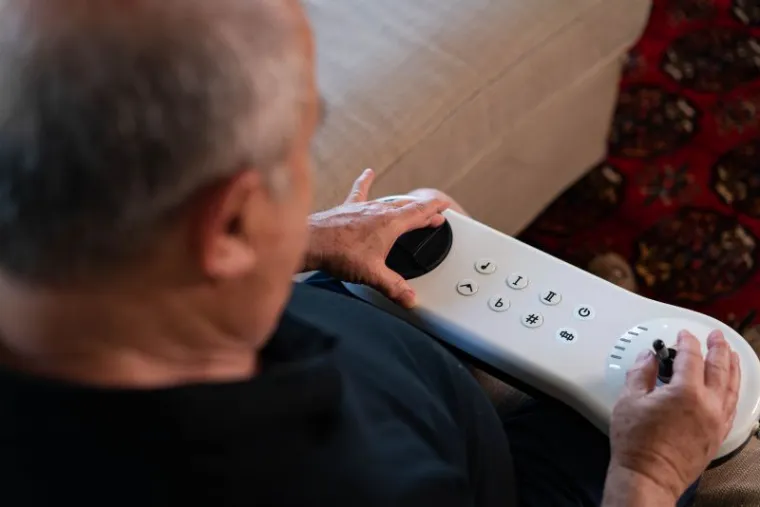
The Arcana Strum was designed to make that process approachable. It produces harmonious tones with simple hand movements, without requiring complex finger placement or sustained grip strength. Because the instrument responds easily, participation feels attainable from the start.
 | Arcana Strum Adaptive Music Instrument - Accessible, Intuitive to Use, and Suitable for All Ages View Product |
This accessibility is especially valuable for Veterans with upper limb injuries, limited hand mobility, neurological conditions, or reduced grip strength. Traditional instruments can increase frustration when they demand fine motor precision. When playing feels physically manageable, the focus shifts from technique to the calming experience of rhythm.
As confidence builds, engagement often deepens. Attention moves from internal tension to external sound, and creating music feels safe rather than demanding. Music therapy for anxiety works best when it feels inviting, and by lowering physical barriers, the Arcana Strum supports the steady participation where benefit grows.
Music can also complement physical rehabilitation in ways that feel purposeful instead of repetitive.
Strumming encourages coordinated, intentional movement across the shoulder, arm, and hand. Because those movements produce immediate auditory feedback, they carry meaning beyond a standard exercise repetition. The sound itself reinforces effort, which can increase motivation during recovery. Over time, this type of engagement may support:
When rehabilitation activities are connected to something creative, consistency often improves. And in recovery, steady participation is often more important than intensity.
Military service requires sustained readiness and rapid response. Recovery requires steadiness and regulation.
Music therapy offers a structured, accessible way to support that shift. Through rhythm and repetition, the nervous system is given something predictable to follow. Adaptive instruments like the Arcana Strum make participation possible for Veterans of varying physical abilities, including those recovering from injury or living with post-traumatic stress disorder.
In many cases, healing begins not with explanation, but with experience. Music provides that experience in a way that is grounded, practical, and sustainable.
Co-Founder of Rehabmart and an Occupational Therapist since 1993. Mike has spent his professional career working in multiple areas of Occupational Therapy, including pediatrics, geriatrics, hand therapy, ergonomics and inpatient / outpatient rehabilitation. Mike enjoys writing articles that help people solve complex therapeutic problems and make better product choices.
 Arcana Strum Adaptive Music Instrument - Accessible, Intuitive to Use, and Suitable for All Ages
.jpg&maxheight=250&width=365&product_name=Adapted Music Kit with Switch Enabled Instruments for Therapy, Classrooms, and Daily Engagement "Adapted Music Kit with Switch Enabled Instruments for Therapy, Classrooms, and Daily Engagement") Adapted Music Kit with Switch Enabled Instruments for Therapy, Classrooms, and Daily Engagement
Adapted Music Kit with Switch Enabled Instruments for Therapy, Classrooms, and Daily Engagement